About us
 Payment & Shipping
 News
News
 Cooperation
 Contacts
-442x255.jpg)
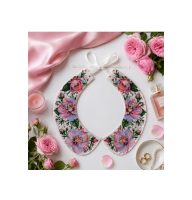
No two beaded collars come out the same. Even from one design, two pieces differ: the thread tension, the tilt of the beads, the way light falls on them. Using the ADC-006 «Citrus Tenderness» kit as an example, here is how bead embroidery on art canvas works, how long it takes and what to do with the finished piece.
Why art canvas is not the same as a chart on Aida
In jewellery kits the design is already printed on the canvas itself, in full colour. You do not check a paper chart or count squares: each bead sits on the patch of its own colour. For a piece that fits around 8,600 beads in twenty-one colours into 250×270 mm, that is a fundamental difference. Counting a pattern like this square by square would be exhausting, and the classic beginner's mistake — a shift by one row — simply cannot happen here.
The second difference is the base. Art canvas is denser than Aida, holds its shape and does not stretch when the surface is fully covered. That is why a finished collar lies flat on the shoulders instead of gathering into folds.
What is in the kit
- Art canvas with the full-colour pattern printed on it.
- Czech Preciosa beads — 21 colours.
- Preciosa microbeads No. 13 — 4 colours.
- Beading needles and a separate finer needle for the microbeads.
- Decorative stones: bicone — 1 pc.
- Velvet ribbon to tie the collar — 60 cm.
- Detailed step-by-step illustrated instructions for the embroidery and for finishing the piece.
The microbeads are not a line added to make the description look richer. They are half the size of the main beads and go where an ordinary bead would be too large: the fine veins of a leaf, the centre of a blossom, the outline of the pattern. They are the reason the colour transitions read as gradients rather than as steps.
How long the work takes
«Citrus Tenderness» is a high-difficulty piece: the canvas is covered completely, background included. Judge the workload by the bead count rather than by the size.
| Pace | Beads per hour | 8,600 beads |
|---|---|---|
| First bead embroidery piece | 200–250 | 35–43 hours |
| A few pieces of experience | 300–400 | 22–29 hours |
| Stitching regularly | 450–550 | 16–19 hours |
In evenings that is roughly three to four weeks at an hour or an hour and a half a day. The exact bead count is listed in the specifications of every kit, so you can work out your own estimate with the same arithmetic.
Where to start
The order of work is simple and the same for any piece of jewellery on canvas:
- Sort the beads into small lidded pots or an organiser and label the numbers. Three shades of yellow on the lemons look identical by eye, and labels save time.
- Start with the large single-colour areas: the leaves, the background. They set the direction the beads lean in for the whole piece.
- Leave the fine detail and the microbeads until later, once your hand has settled into the rhythm.
- Keep the thread tension even. A wavy finished piece is almost never the fault of the design — it is different tension on different evenings.
We covered the stitch itself separately: the monastery stitch and other bead embroidery stitches.
Finishing and wearing
A piece of jewellery needs no stretcher bars or frame — the finishing is part of the project. Following the instructions, the edge is worked, the back is closed and the 60 cm velvet ribbon is sewn in as a tie. The 250×270 mm collar ties over a dress, a shirt or a jumper.
Care is the same as for any beaded piece: no machine washing, store it flat and never fold it in half along the pattern. There is a separate article on that: how to clean a bead embroidery piece and care for it.
If this is your first piece of jewellery
A fully covered collar with 8,600 beads is not the gentlest start. If you have never worked with beads, it makes more sense to begin with a smaller format on the same art canvas: bracelet kits take 1,000–2,000 beads and are finished in a few evenings. The technique is identical, so after a bracelet a collar no longer looks like a big project.
You can choose a design in collars and necklaces and in jewellery kits.
-192x200.jpg "Bead Embroidery Kit on Art Canvas \"Collar “Ethno Code”\"")
-192x200.jpg "Bead Embroidery Kit on Art Canvas \"Collar “Citrus Tenderness”\"")