
 About us
 Payment & Shipping
 News
News
 Cooperation
 Contacts
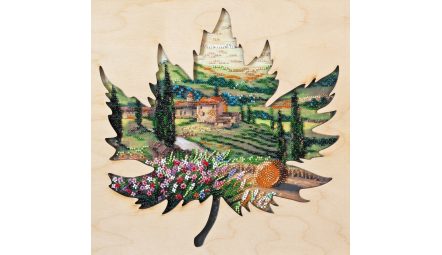
The short answer: a bead-embroidered picture must not be washed — it is cleaned dry. Cross stitch can be washed, and sometimes should be. Below is how care for the two differs, and what to do if a stain has already appeared.
Why beadwork is never washed
The reason is not the beads themselves — glass does not mind water. The problem is everything else in the piece.
- The canvas. Art canvas with a full-colour design printed on it is print on fabric. Prolonged soaking does no print any favours, and streaks across the background cannot be undone.
- The bead finish. Some beads have a metallic, pearlescent or colour-lined finish. Soapy water does not strip it instantly, but the friction of washing does.
- The tension. Wet fabric shrinks, and it shrinks unevenly — densely stitched areas behave differently from open background. A piece that lay flat before washing comes out of it in a wave.
- The thread. Beadwork is dense, with two or three passes of thread through every bead. Moisture trapped inside dries slowly, and that is where a smell later comes from.
So the approach is single: never wet a beaded piece. Not in a machine, not by hand, not "quickly under the tap".
Dry cleaning: how it is done
Routine care for a beaded picture comes down to dust, and it takes two minutes every month or two.
- A soft brush. Use a clean powder brush or a wide natural-bristle brush. Work from top to bottom, lightly, in the direction of the stitching rather than against it.
- A vacuum through gauze. For large pieces: stretch a piece of gauze or nylon over the nozzle, set the lowest power, and hold the nozzle 2–3 cm from the surface without touching it. The gauze will stop a bead being pulled off if a thread has worked loose somewhere.
- A blower or cold air. A rubber lens blower, or a hairdryer on cold at low speed, is the safest option for raised areas.
What you never do: do not shake the piece by its edge (that breaks the thread along the edge of the design), do not wipe it with a damp cloth, and do not run a lint roller over it — the roller catches individual beads and pulls them out.
What to do about stains
The main thing here is not to rush. A stain someone has tried to rub out with water almost always looks worse than a stain left alone.
The sequence
- Lift the excess dry. If something has been spilled, blot with a paper towel, pressing rather than rubbing.
- Let it dry completely.
- Test on the bare margin of the canvas, not on the design: a cotton bud barely damped with clean water, no soap. Watch whether the printed colour shifts.
- If the print holds, treat the stain itself with the bud, spot by spot, with the minimum of moisture. Blot dry immediately.
- Dry flat, face up, at room temperature. Not on a radiator and not in the sun.
Dust and a light greasy film can sometimes be lifted with starch: sprinkle cornflour or talc on the mark, leave it two or three hours, and brush it off gently. The method is not universal, but it is dry, and therefore safe for the canvas.
What must not be used
- An iron. Not from the front, not from the back, not through cloth. Heat ruins the bead finish, pressure cracks beads and flattens the stitching. This is the most common and the most expensive mistake.
- Bleach, stain removers, oxygen cleaners. They act on dye, and dye is exactly what is printed on the canvas.
- Alcohol, acetone, solvents. They strip a bead finish in seconds.
- Hot water. Even warm: above 30 °C the thread and the fabric shrink.
- Dry cleaning. Industrial solvents do not suit coated beads, and no dry cleaner will take responsibility for an item like this.
Caring for cross stitch — this one you can wash
Cross stitch is a different story. The kit contains Aida canvas of the required count and colour, floss, a needle and a chart; there is no print across the whole field and no finish to wash off. A finished piece can be washed, and it often visibly freshens it: over months of work the canvas picks up oil from your hands.
The order is this:
- Soak in cool water (up to 30 °C) for 10–15 minutes with a drop of baby shampoo or a mild bleach-free soap.
- Do not rub and do not wring. Squeeze the piece gently between your palms under the water, and that is all.
- Rinse in several changes of water until the water runs clear.
- Press the water out by rolling in a terry towel, then lay it face up on a dry towel.
- Iron while damp, from the back, through cotton cloth, at a medium setting. Keep the work on something soft — a folded terry towel — so the stitches are not flattened.
One warning: bright floss, especially reds and dark blues, sometimes bleeds. Test before washing by pressing a damp white cloth against the edge of a stitched area for a few seconds. If it leaves a mark, wash in cold water, quickly, and on its own.
If a cross stitch piece has beaded accents, it moves into the beadwork category: no washing, dry cleaning only.
Storing an unfinished piece
A six-month project means six months during which the canvas lives outside a frame. A few habits save a lot of frustration at the finishing stage.
- Roll it, do not fold it. Wind the canvas onto a cardboard tube face outwards, so the beads are not pressed. A crease left for six months will not come out under tension later.
- Do not leave it in the hoop between sessions. Within a week the ring leaves a mark that shows on light canvas.
- Keep it in cloth or paper, not a sealed bag. Polythene with no air movement collects condensation.
- Away from direct sun. The print on the canvas fades faster than the beads, and it shows most on open background.
- Wash your hands before a session and do not work with the piece on your lap. Most stains on beaded pictures are hand oil, building up gradually and showing up towards the end of the project.
- Store beads in closed, labelled containers. Beads scattered on a table get lost, and the same shade is not always available to buy again.
Frequently asked questions
Can a bead-embroidered picture be washed?
No. It is cleaned dry only — with a soft brush, a vacuum through gauze, or cold air. Water deforms the tension, damages the print on the canvas, and can strip the bead finish.
Can bead embroidery be ironed?
No, under no circumstances and from neither side. Heat ruins the bead finish, and the pressure of the iron cracks individual beads and flattens the stitching. Creases in the canvas are dealt with by stretching over bars, not by ironing.
How do I dust a picture that is under glass?
Clean the glass from the outside with ordinary glass cleaner applied to the cloth rather than to the pane, so no liquid runs under the rebate. There is no need to open the frame for dust: under glass the embroidery itself stays clean for years.
There is a grease stain on the work. What now?
First dry starch or talc for two or three hours, then brush it off. If that does not work, treat the spot with a cotton bud barely damped with clean water — but test on the margin of the canvas first to check the print does not run. Do not use soap, stain removers or solvents.
Can cross stitch be washed?
Yes. In cool water up to 30 °C, with a mild bleach-free detergent, without rubbing or wringing. Iron from the back through cloth, with the work lying on a terry towel so the stitches keep their relief.
How should I store a project I have put aside for a long time?
Rolled on a tube face outwards, in cloth or paper, out of the hoop, away from sun and damp. Keep the beads separately in labelled containers, together with the chart and the leftover thread.
The kits described here are bead embroidery and cross stitch; needles, organisers and small storage tools are in accessories and tools.