
 About us
 Payment & Shipping
 News
News
 Cooperation
 Contacts
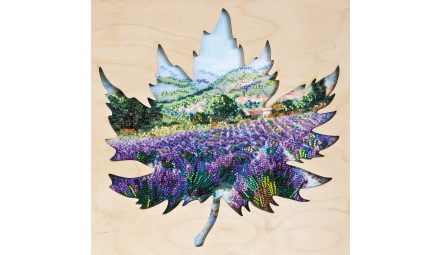
The frame decides how a piece will look on the wall, and it often costs more than the kit itself. So it is worth choosing deliberately: to suit the subject, the size, and the question of whether there will be glass. Here is how it is done and what to ask for at the framer's.
Why there is no frame in the kit
A bead embroidery kit on art canvas contains the canvas with the full-colour design printed on it, Czech Preciosa beads, bead embroidery needles, and an instruction sheet with a framing scheme. There is no frame — and that is not cost-cutting.
There are two reasons. First, the final size of a finished piece depends on how you stretch it. On a 40×50 cm format the difference between tight and loose stretching runs to a centimetre, and a frame packed in the box in advance would either not close or rattle. Second, moulding is a matter of taste and interior. One icon wants warm gold, another a narrow dark batten, and nobody can guess that on the buyer's behalf.
There are exceptions, and they are exactly where the size is fixed: magnet kits include an acrylic base and magnetic tape, and micro-bead pennant kits include an acrylic frame and magnetic tape. There the mounting is built into the design and nothing needs choosing.
Matching the frame to the size of the work
A frame is measured not by its outer perimeter but by the rebate — the inner channel the work drops into. The rule is simple: the inner dimension should be 2–4 mm larger than the stretched piece on each side. Less and it will not go in; more and you will see a gap.
Below is a table of reference sizes. The left column is the embroidered area, the middle one the standard moulding format that fits it, and the right one the size if you add a 5 cm mount.
| Size of the work | Frame without a mount | Frame with a 5 cm mount |
|---|---|---|
| 100×150 mm | 10×15 cm | 20×25 cm |
| 150×150 mm | 15×15 cm | 25×25 cm |
| 180×240 mm | 18×24 cm | 28×34 cm |
| 200×300 mm | 20×30 cm | 30×40 cm |
| 240×300 mm | 24×30 cm | 34×40 cm |
| 300×400 mm | 30×40 cm | 40×50 cm |
| 400×500 mm | 40×50 cm | 50×60 cm |
| 500×700 mm | 50×70 cm | 60×80 cm |
Standard formats are a third cheaper than custom ones or better, so it makes sense to adjust your stretching to fit them rather than the other way round. If your piece is 195×290 mm, choose stretcher bars so that it lands in a 20×30 cm frame — it will save you a noticeable amount.
Choosing the moulding for the subject
The moulding should not compete with the work. The general rule: the busier and more colourful the subject, the calmer the profile and the less gold.
- Icons and talismans. Warm gold, antique gold, dark wood with a thin gold line. A width of 4–7 cm on medium formats: an icon likes a substantial frame. Cold silver and white plastic are best avoided.
- Flowers and still lifes. A mid-width batten, 3–5 cm, matching the darkest or lightest detail in the design — but not the dominant mass of colour, or the picture will dissolve into the frame.
- Landscapes. A narrow 2–3 cm profile and, always, a mount: it adds air and reads like a window you are looking through.
- Abstract, modern graphic, folk motifs. A flat black, white or natural wood batten of 2–3 cm with no ornament.
- Children's subjects. A coloured moulding is fine, but only if the colour repeats one already in the work rather than introducing a new one.
A practical trick at the framer's: ask them to hold corner samples of three or four mouldings against the work, then step back two metres. From that distance you see what you cannot see from one metre away — and a picture on a wall is seen from exactly there.
Mounts: when you need one and which
A mount is a card frame with a cut window that sits between the work and the moulding. It does two jobs: it gives the subject space and, more important for beadwork, it holds the glass away from the stitching.
A mount is rarely narrower than 4 cm — anything less looks like a cutting error. The classic proportion has the bottom margin 0.5–1 cm wider than the sides, so the picture does not appear to slide downwards. Take the colour from the work itself, from its lightest areas; a bright white mount rarely suits, because canvas is never that white and the difference jumps out at once.
Large personalised icons are usually framed without a mount: the subject fills the field completely and does not need air around it.
Glass or no glass
This is the central question for beadwork, and there is no single answer.
The case for glass
Glass keeps dust out. Bead embroidery has a textured surface with thousands of hollows, and dust settles into them for good — under glass a piece looks the same after five years as it did after one. Glass also protects the thread from damp and from kitchen grease, if the picture is not hanging in a living room.
The case against
Beads work through reflection: they come alive when light hits each bead at its own angle. Glass mutes that play and adds a reflection of its own, so some of the depth is lost. And glass must not touch the beads. Pressed against the pane, the stitching flattens, and in a sealed space with no air gap condensation collects.
The compromise
If you go with glass, it has to stand off. That distance comes either from a mount or from a spacer in the rebate. The gap between the glass and the highest point of the beadwork should be at least 3 mm. For work with large beads or raised elements, at least 5 mm — and then you need a deep moulding.
Non-reflective glass
Etched non-reflective glass diffuses reflections, but it suits beadwork poorly: it dulls exactly the sparkle beads are chosen for, and from a distance it adds a faint milky haze. Anti-reflective museum glass works far better — it is almost invisible and does not kill the sparkle — but it costs several times more than ordinary glass. On a limited budget it is smarter to use plain clear glass with a proper stand-off than etched glass sitting flat on the work.
For cross stitch it is all simpler: the surface is flat, there is no sparkle to lose, and non-reflective glass is a perfectly good choice.
Frequently asked questions
Why is there no frame in the kit?
Because the final size of the work depends on how it is stretched, and the choice of moulding depends on the room. The kit contains the printed canvas, Preciosa beads, needles and an instruction sheet with a framing scheme. The exceptions are magnets and micro-bead pennants: their mounting is included, because the size is fixed.
What frame size do I need for a 30×40 cm piece?
A standard frame with a 30×40 cm inner size if you frame without a mount, or 40×50 cm with a 5 cm mount. The rebate must be 2–4 mm larger than the stretched piece, otherwise it will not go in.
Can bead embroidery go under glass?
It can, but only with a gap of at least 3 mm between the glass and the beads. The stand-off comes from a mount or a spacer in the rebate. Flat against the work, glass flattens the stitching, and a sealed space accumulates condensation.
How much does framing cost?
It depends on the perimeter and the profile, and no figure can be quoted in advance. A guide for the conversation at the framer's: moulding is priced by the running metre, mounts by the sheet plus cutting, glass by area. Profile width and glass type affect the price far more than the size of the picture itself.
Do I have to take the work to a framer?
Not if you have stretched it yourself and are buying a ready-made frame in a standard format. Go to a framer when you need a mount with a precisely cut window, a non-standard size, or glass with a stand-off — they will do it faster and more neatly than you can at home.
What if the work will not fit into the rebate?
Check the corners: nine times out of ten the obstruction is a thick fold of fabric at a corner rather than the size itself. Refold the corners like an envelope and trim the excess. If that does not help, the piece has been stretched over oversized bars and they need changing.
The subjects most often given a heavy moulding are gathered in icons and talismans, pieces that suit a mount are in medium kits, and the formats where the mounting is already included are in magnet kits.