
 About us
 Payment & Shipping
 News
News
 Cooperation
 Contacts
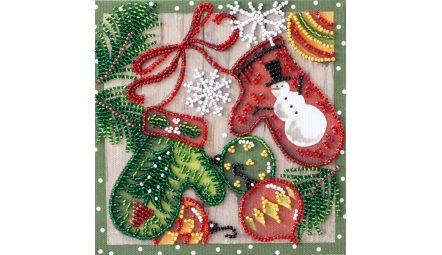
The first kit decides whether there will be a second one. People usually give up not because "it did not work out", but because they took on a hundred-and-twenty-hour piece expecting two evenings. Here is how to see that in the specifications in advance.
Size is the main parameter
Size determines nearly everything else: bead count, time, price, and how fine the details will be. For a first piece it makes sense to pick a format you will finish in two or three weeks rather than six months.
| Format | Approximate size | Beads | Time for a beginner |
|---|---|---|---|
| Mini, magnet, keyring | up to 10×15 cm | 1,000–3,000 | 4–12 hours |
| Small | 15×20 to 20×25 cm | 4,000–10,000 | 15–35 hours |
| Medium | 25×30 to 30×40 cm | 12,000–25,000 | 40–90 hours |
| Large | from 40×50 cm | 30,000 and above | 100 hours and more |
The figures in the time column are a guide, calculated from a pace of 250–400 beads an hour. The exact bead count and size are given in the specifications of each kit, so you do not have to rely on the table: multiply your own count by 3–4 minutes per hundred and you get your own estimate.
For a first piece a sensible choice is a mini kit or a small format. The value of such a piece is not in its size but in the fact that you go through the whole cycle: unpacking, the first row, the long monotonous background, the last beads, the framing. After that you know whether you want a medium format.
Bead count and number of colours
Bead count is an honest unit of labour. Size can mislead: on art canvas the beads do not cover the surface completely, part of the image stays as print, so two pieces of the same format can differ twofold in the amount of beading.
The number of colours works differently. It is not about the difficulty of the stitch but about attention:
- Up to 12 colours — they all fit in front of you in a single row of lids, and mix-ups are rare.
- 15–25 colours — you need a labelled organiser, because two or three shades will be very close.
- Over 25 colours — this is work with subtle gradients. Beautiful, but every few rows you will be checking the chart and the number.
For a first piece, 10–18 colours is a comfortable range. Fewer and the subject may look flat; more and sorting fatigue sets in.
Difficulty level: what is behind it
The difficulty level is stated in the kit specifications, but the label alone explains nothing. Behind it sits a combination of four things, and you can check each one yourself.
- Beaded area. The larger the share of canvas covered with beads, the longer the work. You can see it in the photo: look at how much clean print is left.
- Size of the smallest detail. Faces, hands, lettering, thin branches — places where a one-cell error shows immediately. Large blocks of colour are far more forgiving.
- Number of close shades. Five gradations of skin tone or seven of blue make for slow work even when the bead count is modest.
- Finishing involved. Magnets, keyrings and cards have an assembly stage after the stitching; a picture needs stretching and a frame.
A practical rule: if in the product photo you cannot make out the separate features of a face or a fine ornament at arm's length, the design is demanding for a first attempt.
Subject: why it is not a secondary question
You will spend dozens of hours with this image. A subject that is merely "all right" turns into an obligation by the third evening. So choose something you actually want to hang or to give.
A few practical considerations:
- Flowers, still lifes and landscapes have large uniform zones — they forgive small inaccuracies and go quickly.
- Portraits and faces are the most demanding: there is no "roughly right" shade there.
- Icons have clear borders and a lot of plain ground, but call for accuracy in the faces. The icons and amulets section has both large and small formats.
- Geometry and ornament are the easiest start, because a mistake shows at once, while it is still easy to correct.
How long it will really take
The arithmetic is simple. A beginner places 250–400 beads an hour; after a few pieces the pace rises to 500–700. Take the bead count from the specifications, divide by 300, and you have hours. Divide the hours by the number of evenings you realistically have each week, and you have a date.
A realistic pace for someone with a job is 4–6 hours a week. So:
- 3,000 beads — about 10 hours, that is two weeks.
- 10,000 beads — about 33 hours, that is a month and a half to two months.
- 25,000 beads — about 80 hours, that is four to five months.
If the piece is needed by a specific date — a present, a holiday — allow one and a half times the estimate. The first hours are always slower than the ones that follow.
What to plan for beyond the kit itself
A bead embroidery kit on art canvas contains the canvas with a full-colour chart printed on it, Czech Preciosa beads, beading needles, and an instruction sheet with the framing chart. Everything else you choose yourself: thread, scissors, dishes for the beads, a lamp, and optionally a hoop or frame. It is not expensive, but it is worth arranging in advance so you are not hunting for thread on the first evening.
Think about the finishing separately. A picture will need stretching and a frame — a separate cost and a separate errand. Magnets and keyrings do not: magnet kits already include an acrylic base and magnetic tape, so the work becomes a finished object on the same evening you place the last bead.
Frequently asked questions
What size should I start with if I have never embroidered?
A format up to 15×20 cm with 3,000–5,000 beads. That is 10–20 hours — enough for your hand to learn the tension, and little enough not to wear you out. Magnet kits have the added advantage of needing no framing.
Do I need cross stitch experience first?
No. They are different techniques, and bead embroidery on canvas with a printed chart is arguably the easier start: you do not count cells on blank fabric or compare against a paper chart, because the colour is visible right under the needle. Cross stitch experience helps mainly with tension and with how you sit.
What does the bead count in the specifications mean?
It is the approximate total number of beads that will be sewn onto the finished piece. It is the convenient basis for estimating time: one bead, one stitch. The number of colours is given separately and affects concentration more than it affects hours.
What do I do if beads get spilled?
Collect everything you can, straight away. Beads are easy to find by wiping the floor with a damp cloth or shining a torch across it at a low angle. A spilled lid of a rare shade is worth collecting in full: sourcing the same Preciosa number is possible, but it is a separate errand and a pause in the work.
What should I choose for a child?
A format up to 10×15 cm with larger beads and a simple geometric or cartoon subject — or better still a craft kit with a shorter cycle. A child's attention holds for 20–40 minutes, so what matters is not the difficulty but the chance to see a result within a few sessions.
Can price be used as an indicator of difficulty?
Only partly. Price depends on the size of the canvas and the amount of beads and colours — that is, on the volume of materials, not on how hard it will be for you. A small piece with a dozen close skin tones can turn out harder than a landscape three times the price with large uniform zones.