
 About us
 Payment & Shipping
 News
News
 Cooperation
 Contacts
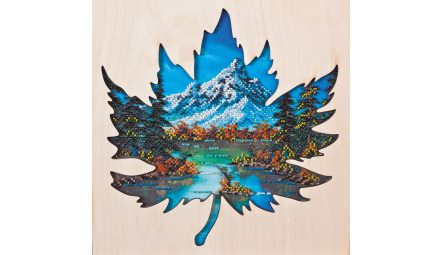
The question "how long will this take" comes up before the kit is even bought, and an honest answer is calculated, not guessed. The figure to work from is not the size of the picture but the number of beads — and that number is given in the kit description. Here is how to turn it into hours and evenings.
The unit is the bead, not the centimetre
Two kits of the same size can differ twofold in time. The reason is simple: on art canvas the beads do not cover the whole surface. Part of the image stays as print, and only what needs relief is stitched. A 30×40 cm piece stitched solid and a 30×40 cm piece where only the figure is picked out in beads are different projects.
So go by the bead count. It is stated in the description of every kit, and it converts directly into time.
Realistic stitching speeds
Speed is measured in beads per hour of actual stitching — not counting hunting for the needle, sorting beads, and tea.
- The first few hours after starting: 80–150 beads an hour. That is normal; it is the period when the hand is learning.
- A confident beginner with three to five pieces behind them: 150–250 an hour.
- An experienced hand working on a hoop or a stand: 250–350 an hour, and up to 400 across large uniform areas of background.
For planning, use a range of 150–300 beads an hour. It covers most real cases and does not set up false expectations. Every figure in the table below is based on that range.
Table: bead count to approximate time
| Number of beads | Stitching time | Evenings of 2 hours | Typical format |
|---|---|---|---|
| about 1,000 | 3–7 hours | 2–4 | magnet, keyring, mini piece |
| about 2,500 | 8–17 hours | 4–9 | mini icon, greeting card |
| about 5,000 | 17–33 hours | 9–17 | small picture, 15×20 cm |
| about 10,000 | 33–67 hours | 17–34 | medium picture, 20×30 cm |
| about 20,000 | 65–130 hours | 33–65 | large picture, 30×40 cm |
| about 35,000 | 115–230 hours | 58–115 | large personalised icon |
Read the table realistically. A 20,000-bead piece at two evenings a week is four months and up. That is not a reason to avoid it — it is a reason not to promise it to someone for a birthday three weeks away.
What determines your speed
Bead size
The smaller the bead, the slower the work — and the difference here is severalfold, not marginal. Size 13 microbeads, used in jewellery and pennant magnets, need a fine needle, good light and a short working distance. On pieces like that 100 beads an hour is already a decent pace, and you should allow at least twice the time the table above suggests.
Number of colours
Every colour change is a pause: secure the thread, find the right packet, pick up a new batch. A piece with 8 colours has few pauses. A piece with 30 colours and fine colour transitions can lose up to a third of its time to them. So a busy subject is always slower than a calm one at the same bead count.
The nature of the subject
Large uniform areas — sky, water, background — stitch quickly and evenly. Faces, hands, fine ornament and lettering go slowly, with constant checking against the chart and unpicking. In an icon the face and hands take longest, and they occupy the smallest area.
Conditions
- Light. A neutral-white lamp placed to the side improves speed more than any stitching technique. Under overhead light in the evening the pace drops by roughly a third.
- Hoop or stand. Working in the hand ties up one hand and slows you down. On a stand you work with both, and the difference is noticeable.
- Bead organisation. Beads laid out in an organiser or in small lids save more time than you would think: hunting for a colour in a pile of packets eats minutes dozens of times an evening.
- Session length. The first 15 minutes of any session are warm-up. Two one-hour sessions are therefore slower than one two-hour session.
How much you get done in an evening
The most common pattern is an hour or two after work. Two hours of actual stitching at an average pace comes to 300–600 beads. That is roughly a 4×4 cm patch of dense coverage, or a larger stretch of open background.
Visually not much changes in an evening, and that is exactly where people abandon large pieces in the second month. It helps to stop measuring progress in square centimetres and start measuring it in rows or colours: "I finished the blue today" is a tangible result, "I covered 3 cm today" is not.
Breaking a large piece into stages
A 100-hour project needs a plan, or it turns into an infinity. A working approach looks like this:
- Measure your own pace in the first hour. Note the time, stitch for an hour, count the rows and multiply by the beads per row. Now you have your own number rather than an average from the internet.
- Split the design into 5–8 zones — not equal in area but logical: background, clothing, ornament, face, fine details. Each zone is a separate "project" with its own finish line.
- Start with the large and simple. Background gives fast visible progress and builds momentum at the start, when motivation is most fragile.
- Put the hardest part in the middle, not at the end. Faces and fine ornament are best tackled when the hand is confident but the interest has not burned out.
- Set your quota in beads, not in time. "Two hundred beads today" is achievable even on a bad day. "An hour of stitching" is an obligation, and obligations get skipped.
- Keep notes. Date and number of rows on a sheet in the kit box. After a month those notes give you an accurate forecast to the finish.
One more thing: a break does no harm. Canvas rolled on a tube and put in a cupboard will wait a year quite happily. What does harm is a kit folded in half a few times and shoved into a bag with loose beads.
Frequently asked questions
How long does a 30×40 cm bead embroidery take?
Roughly 65–130 hours if the piece has about 20,000 beads. At two two-hour evenings a week that is four to eight months. A closer estimate comes only from the bead count of the specific kit — size on its own says little, because beads on art canvas do not cover the whole surface.
How many beads can I stitch in an hour?
From 80–150 in the first hours after starting to 250–350 for an experienced hand. For planning, use 150–300 an hour. On size 13 microbeads the pace is half that.
Which piece should I start with so that I actually finish it?
One that fits into 10–20 hours: roughly 2,000–4,000 beads. That means a mini kit, a magnet or a greeting card. You will go through the whole cycle, see a finished result and learn your own pace — after that a large format feels quite different.
Why do two pieces of the same size take different amounts of time?
Because of the bead count, the number of colours and the nature of the subject. On art canvas the beads do not cover the whole field, so two 30×40 cm pictures can differ twofold. A busy subject with 30 colours is slower than a calm one with 10 at the same bead count.
Can I finish a piece as a gift within a month?
Realistically yes, if the kit has up to 5,000 beads and you stitch at least four evenings a week: that is 17–33 hours of actual work. Anything above 10,000 beads will not fit into a month at a normal pace.
Does a stand speed things up?
Yes, by roughly a quarter to a third, because both hands are free and the canvas holds constant tension. On small pieces the gain is eaten up by setting up and repositioning, so a stand starts to pay off from about 20×30 cm upwards.
Short pieces for an evening or two are the mini kits and magnets, while projects that run for months are the large bead embroidery kits.