
 About us
 Payment & Shipping
 News
News
 Cooperation
 Contacts
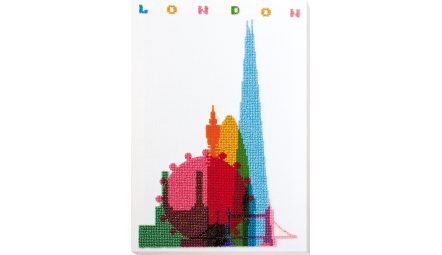
In bead embroidery the stitch decides how each bead sits, how the surface behaves under light, and how much thread you get through. Here are the four stitches you meet most often: the monastery stitch, the ribbon stitch, the arch stitch and the vertical stitch.
What the stitch actually changes
A bead is not a dot of paint but a three-dimensional glass body with a hole through it. The path of the thread decides four things at once.
- Slant. A bead can sit on the diagonal of a cell, stand upright, or lie along a drawn line. The slant catches the light: a diagonal surface shimmers at an angle, an upright one glows evenly.
- Density. With identical beads, the stitch changes how tightly they touch each other side to side.
- Distortion of the canvas. Stitches with long runs on the back pull the ground harder.
- Thread consumption. Over the same area the difference between stitches reaches one and a half times.
It is not always a matter of taste: a chart printed on canvas in cells is already designed around one particular stitch.
The monastery stitch
This is the most common stitch in kits on art canvas, and the one everybody starts with. It is essentially a half-cross with a bead riding on it.
The needle comes up at the bottom left corner of a cell, one bead is picked up, and the needle goes down into the top right corner of the same cell. On the back it travels to the bottom left corner of the next cell, and so on along the row. The reverse side shows short vertical or horizontal stitches, depending on the direction of the row.
Why kits are built around it
The monastery stitch maps onto a cell without ambiguity: one bead, one chart cell, almost nothing to get wrong. It produces the same slant across the whole area, so a large beaded surface reads as one piece rather than a set of fragments. Its reverse side is economical, and the technique is learned within a dozen rows. Charts in the bead embroidery kits are drawn for exactly this stitch.
What to watch for
The slant must be identical throughout the piece, from the first bead to the last. If one part leans one way and another part the other way, a clear seam appears under side light, and the only fix is unpicking. So choose the direction at the start and write it down for yourself: "bottom left up to top right", for example.
The ribbon stitch
The same diagonal stitch, but the rows run diagonally rather than horizontally: you work a track at 45°, then the next one right beside it in the opposite direction.
The gain is that tension is spread more evenly across both directions of the ground, so the canvas warps less. On large plain areas — sky, an icon background, water — the ribbon stitch noticeably reduces waviness. There is a cost: counting cells on the diagonal is harder, and on small details with frequent colour changes this stitch gets in the way. It is usually taken for backgrounds, with the details finished in monastery stitch.
The arch stitch
Here several beads — usually three to five — go on one stitch and are laid in an arc, then held down with couching stitches so the arc does not sag. The beads sit along the line you are drawing rather than in cells.
This is not a stitch for grid charts but for free embroidery: outlines, branches, lettering, edge decoration, beadwork on clothing and accessories. It gives a live, flexible line that cells cannot achieve, but it needs control: without couching the arc lifts off the fabric and snags. For filling large areas densely the arch stitch is unsuitable.
The vertical stitch
The bead is fixed with a vertical stitch and stands upright, hole running bottom to top. Rows run horizontally, beads within a row touch side by side, and the rows stack like brickwork.
The surface comes out flatter and finer in pattern than with the monastery stitch, and the shine is calmer because every bead faces the same way. This stitch suits small details, subtle colour transitions and work with microbeads — including the microbead embroidery kits, where the bead is half the size and the slant barely reads. The price is higher thread consumption and a slower pace.
Stitch comparison
| Stitch | Beads per stitch | How the bead sits | Where it belongs | Thread use | Difficulty |
|---|---|---|---|---|---|
| Monastery | 1 | On the cell diagonal, one constant slant | Printed charts, any subject, the whole piece | Moderate | Low |
| Ribbon | 1 | On the diagonal, rows running at 45° | Large plain backgrounds, icon grounds, sky, water | Moderate | Medium |
| Arch | 3–5 | In an arc along a line, outside the cells | Outlines, lettering, embroidery on clothing and jewellery | Low | Medium |
| Vertical | 1 | Upright, rows stacked like brickwork | Fine detail, microbeads, jewellery | High | Medium |
How to keep the slant and the density
- Decide the stitch direction before the first bead and hold to it for the whole piece, even when you come back a month later.
- Check the slant every ten beads and at the end of every row. One turned bead is visible from a distance.
- Do not change stitch in the middle of a uniform area. If the background is ribbon and a detail is monastery, the border should coincide with a border of colour or shape, not fall at random.
- Keep the tension constant. A slight difference in pull produces bands of different density, most visible on a plain ground.
- Make sure the thread is not too thick for the hole: a bead sitting tightly on the thread twists out of line.
Can stitches be mixed in one piece?
They can, and experienced stitchers do exactly that: ribbon for the background, monastery for fine detail, vertical for individual accents. There is one rule — the transition between stitches must coincide with a logical border in the image. A border running through the middle of an even ground draws more attention than any benefit the change of technique brings. For a first piece it is simpler to work everything in monastery stitch and leave the experiments for the second or third. Small formats from the mini kits are convenient for such trials: a mistake costs an evening, not a month.
Frequently asked questions
Which stitch is used in Abris Art kits?
The monastery stitch. The chart printed on the art canvas is divided into cells sized for one bead on one diagonal stitch — that is the monastery stitch. The other stitches are your own choice for particular areas, not a replacement for the basic technique.
How does the monastery stitch differ from a half-cross in thread?
Geometrically it is the same: one diagonal stitch per cell. The difference is that a bead rides on the stitch, so the stitch must be exactly as long as the bead — no longer and no shorter. That is why tension is controlled more strictly in bead embroidery than in thread embroidery.
Why does the work skew even though I use a single stitch?
Usually because of uneven tension and because every stitch pulls the ground the same way. The monastery stitch has a one-sided diagonal by nature, so over large areas the ground gradually shifts. Three things help: a frame or hoop, ribbon stitch on the background, and breaks during which the canvas lies flat.
How many beads can go on a single stitch?
In the monastery, ribbon and vertical stitches — exactly one. Several beads at a time belong only to the arch stitch, and there the arc must be couched down, otherwise it sags and snags.
Which stitch holds up better on clothing?
Arch and vertical. They leave fewer long stitches on the reverse and cope better with fabric that moves. The monastery stitch is used on clothing too, but mostly on a dense ground and over small areas. Ready-made designs for this are in the bead embroidery on canvas for clothing section.
Can an area be re-stitched with a different stitch if I do not like it?
It can, carefully. The beading is unpicked by catching the thread on the reverse with a fine seam ripper and taking the beads off one by one — they can be reused. The canvas should then lie flat for a day or two so the needle marks close up. Re-stitching an area larger than your palm is rarely worth it: starting fresh with the next kit will be quicker and neater.