
 About us
 Payment & Shipping
 News
News
 Cooperation
 Contacts
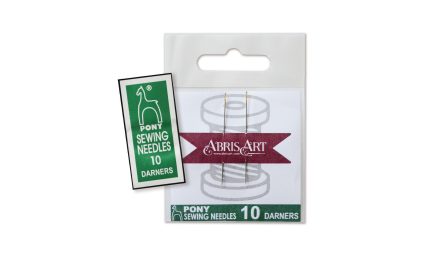
The needle, the thread and the hoop are the three things that make bead embroidery either run smoothly or turn into a fight with your materials. Below is what size needle to use with what size bead, how a beading needle differs from a sewing one, which threads can carry the weight of glass, and when a hoop genuinely helps rather than gets in the way.
How a beading needle differs from an ordinary one
The main difference is the eye. On a sewing needle the eye is wider than the shaft: it thickens the needle at exactly the point that has to pass through the bead. That is why a sewing needle enters the hole with its tip and jams at the eye. A beading needle is the same thickness along its whole length, and its eye is elongated and lies flat in the plane of the needle, so both the tip and the eye with the thread pass through the hole.
The second difference is springiness. Beading needles are thin and noticeably more flexible than sewing needles. They bend slightly as you run them under stretched fabric, and that is normal behaviour, not a defect. The flip side is that they break more easily, especially if you pull the needle sideways or force it into a tight hole. Beading needles are already included in Abris Art kits, but one or two spares on hand will save you an evening.
The third difference is length. Short needles (roughly 25–30 mm) are more obedient and stronger, and they are comfortable for sewing beads down one at a time onto a dense base. Long ones (45–55 mm) are for work where you pick up several beads at once: stringing, edging, assembling jewellery. For embroidery on art canvas a short or medium needle is the usual choice.
What needle size for what bead size
There is one rule and it is easy to remember: the higher the number, the thinner the needle. Beads work the same way — the higher the number, the smaller the bead. That is why needle and bead numbers usually sit close together.
| Bead size | Approximate bead diameter | Needle size |
|---|---|---|
| No. 6 | about 4 mm | 10 |
| No. 8 | about 3 mm | 10–11 |
| No. 10 | about 2.3 mm | 11–12 |
| No. 11 | about 2.1 mm | 12 |
| No. 13 (microbeads) | about 1.6–1.8 mm | 13–15 |
The table is a guide, not a rule carved in stone. Look at the actual batch: Czech beads have even holes, but even within one size you will meet beads with a narrower channel. If the needle goes through with effort, take one size thinner — forcing it is exactly what pricks your fingers and cracks beads.
There is one more consideration that is rarely mentioned. In embroidery on art canvas each bead is sewn down with a single pass of thread, so you can afford a needle one size thicker — it is stronger and bends less. But as soon as the thread has to go through a bead twice or three times (securing an edge, assembling jewellery, stringing), go thinner straight away: the second pass has to stay free.
Microbeads are a separate story
Preciosa microbeads No. 13 are roughly half the size of the familiar No. 10, and the hole is proportionally smaller. A No. 11 needle simply will not enter, and trying to force it ends in a broken needle or a cracked bead. Kits for microbead embroidery already include a needle of the right size — which is why they should not be "topped up" with needles from an ordinary kit. Add good light and, if you need it, a magnifier: here the time lost hunting for the hole outweighs the embroidery itself.
Threads: what holds beads
Thread for beadwork works in harsh conditions. It rubs against the glass edge of the hole, carries the weight of the bead and must not stretch, otherwise the rows sag over time. So there are three requirements: breaking strength, resistance to abrasion and minimal stretch.
- Reinforced polyester threads are the everyday working option. Thin, strong, they hold their shape and knot well. For No. 10 beads a nominal thickness of 50 is convenient.
- Dedicated nylon beading threads, flat or round, are the most abrasion-resistant. Choose them for jewellery and for work where the thread passes through a bead several times.
- Monofilament (nylon line) is transparent, so you never have to match a colour. But it is slippery: knots work loose, and with time or cold it can become brittle. It is used less often on large canvases.
- Stranded cotton floss is not an option for sewing beads. It is made of twisted fibres that separate and abrade against the glass edge. Keep floss for cross stitch, where it belongs.
Match the thread colour to the canvas rather than to the beads: it is the thread that shows between them. The exception is transparent and semi-transparent beads, through which the thread shows straight through; there, match the bead itself.
Cut no more than 40–60 cm at a time. A longer thread twists, frays at the end and knots more often — you will not gain from rethreading less frequently. Waxing with beeswax or a silicone conditioner noticeably reduces fuzz and the number of self-made knots. Secure the thread not with one big knot but with two or three small stitches on the back: a large knot shows as a bump under the canvas and gets in the way when you mount the work.
Hoops: when you need them and when you do not
A hoop does one thing — it holds even tension. That determines whether the beads lie uniformly and whether the canvas pulls in by the end of the work. But even tension is not always required.
You can work without a hoop when the piece is small and the canvas is dense: magnets, keyrings, cards, mini kits, small talismans. These formats sit comfortably in your hand, and an extra hoop only makes it harder to turn the work.
It is worth using a hoop when the embroidered area is larger than your palm, when rows are long and continuous, when the canvas is thinner, or when you notice the edge starting to curl. On large icons and pictures tension decides everything: without it the beads lie in waves, and it shows once the piece is framed.
- Plastic hoops with a screw grip tightest, the tension is adjustable and they leave almost no marks on the canvas.
- Wooden hoops are cheaper but grip more weakly; wrapping the inner ring with a narrow strip of fabric stops the canvas from slipping.
- Tapestry frames and stands suit medium and large pieces. The canvas is stretched once, both hands stay free, and that noticeably speeds up the work.
Choose a size that lets the working area fit inside completely. Never clamp an already beaded area in the hoop: the beads are pressed into the canvas, the threads deform and a crease stays in the fabric. For the same reason, take the work off the hoop whenever you put it aside for a long while.
Needle case, needle threader and seam ripper
These are the small things people buy last and then wonder how they managed without.
- A needle case, magnetic or with felt pages. Needles stop disappearing into the sofa, staying on the armchair or travelling around the flat. If there are children or pets in the house this is not convenience but safety: count your needles before a break and after you finish.
- A needle threader is a thin metal loop you push through the eye, lay the thread into it and pull back. For beading needles choose the finest threaders: the ordinary sort, made for sewing needles, will not fit a No. 12 eye.
- A seam ripper is needed less often than in cross stitch, but when a bead is sewn in the wrong place, cutting the thread with it is far safer than working with scissors next to finished rows.
All three are in the small tools section; needles, beading threads and hoops are sold separately.
Frequently asked questions
What needle do I need for No. 10 beads?
A No. 11 or No. 12 needle. The 11 is stronger and works when the thread passes through the bead once; the 12 is thinner and needed where there are two passes or more. If the needle goes through tightly, switch to a thinner one rather than forcing it.
Can I use an ordinary sewing needle for beadwork?
Only with large beads, No. 6 or No. 8. A sewing needle has an eye wider than its shaft, so it will not pass through a smaller bead. For No. 10 and finer you need a proper beading needle with an elongated eye.
Why does my needle bend and break?
Usually because it is being forced into too narrow a hole, or pulled sideways instead of being led straight. Flexibility is designed into a beading needle; breakage, however, is almost always a signal to go one size thinner.
Can I sew beads on with stranded floss?
No, it is not suited to it. Floss consists of fibres that separate and abrade against the sharp glass edge of the hole, so the stitching weakens over time. Use reinforced polyester or nylon threads and keep floss for cross stitch.
Do I need a hoop for a magnet kit?
No. Small formats — magnets, keyrings, cards, mini kits — are comfortably worked in the hand: the area is small and the canvas is dense enough not to pull in. A hoop becomes useful from roughly palm-sized pieces upwards.
How much thread should I cut at a time?
40–60 cm. A longer piece twists, frays and tangles, and you save less time on rethreading than you lose untangling knots.